Event
Ministry of Finance studies amendments to the Law on Procurement and Employment with State Funds (Amended)
February 13, 2026
4 months ago
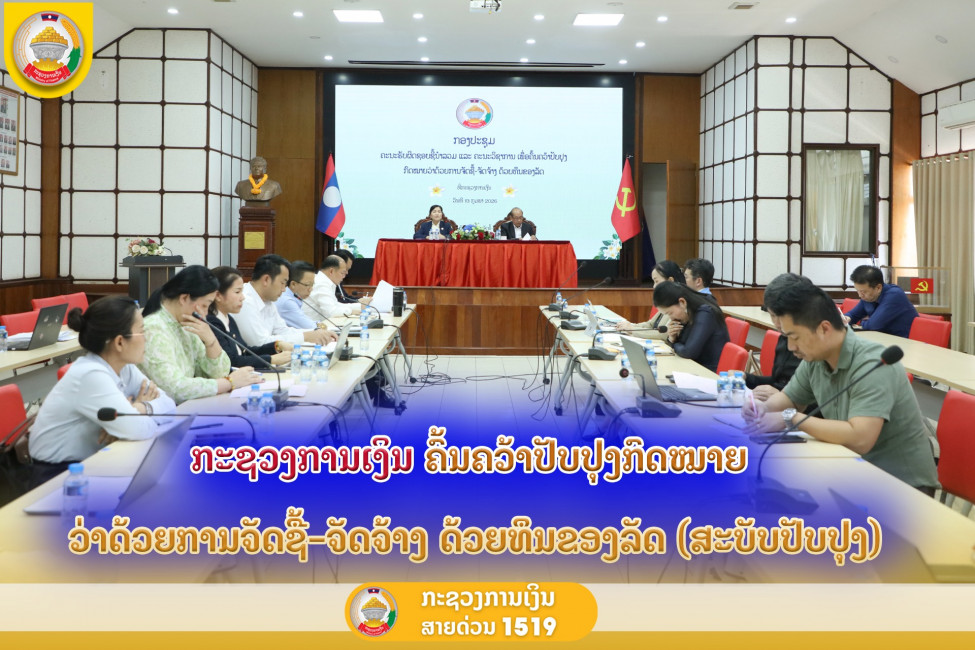
On February 13, 2026, the Ministry of Finance held a meeting of the Joint Steering Committee and the Technical Committee to study the revision of the Law on Procurement and Employment with State Funds, co-chaired by Ms. Phonevanh Outhavong, Deputy Minister of Finance, and Mr. Kongji Yangchung, Deputy Minister of Justice, with the participation of departments and technical committees of the two ministries. This meeting was to study the creation of a “draft” of the Law on Procurement and Employment with State Funds (amended). Ms. Phonevanh Outhavong, Deputy Minister of Finance, said: Procurement and employment with state funds is an important task in managing state expenditures and combating waste in accordance with government policies to maximize the effectiveness of state budget use; Therefore, in 2017, the National Assembly approved the Law on Procurement and Employment with State Funds No. 30/NA, dated November 2, 2017, to implement the law in the past. Currently, the law needs to be revised to reflect the current situation, fluctuations in market prices, imported goods, inflation, which is the main reason for the difficulties in implementing public procurement and contracting, and some of the contents that have been suggested by procurement units of ministries, organizations, and the public to be revised. There are also various documents related to procurement and contracting, especially the implementation of laws that are important in implementing the law, including the need to introduce procedures for public procurement and contracting to be detailed, clear, transparent, and verifiable. In response to the demands of this work, an agreement was issued on the appointment of a joint steering committee and a technical committee to study and improve the Law on Public Procurement and Employment No. 0262/Kong, dated January 22, 2026. The amendment of this law aims to make the implementation more effective, including: 1. The management organization for public procurement and employment; 2. The use of electronic procurement and employment (E-procurement); 3. Decentralization between the center and local governments, such as the central budget but projects located in the localities; 4. Measures to manage and use the public procurement and employment website of ministries, central-level organizations and down to the local level to centralize various information on the implementation of procurement and employment and to publish various invitations to bid in a modern system that everyone can access information quickly and easily; 5. Setting detailed conditions for the narrow bidding format; 6. The distribution of bid packages and the sale of bid packages, which are still limited to a single point, must be open to the public, with multiple locations where bidders can interact and buy bid packages, increasing the conditions for real competition and greater competition; 7. Determine measures against parties that conduct bidding improperly; 8. Review projects with abnormally high bid prices and other issues.
On February 13, 2026, the Ministry of Finance held a meeting of the Joint Steering Committee and the Technical Committee to study the revision of the Law on Procurement and Employment with State Funds, co-chaired by Ms. Phonevanh Outhavong, Deputy Minister of Finance, and Mr. Kongji Yangchung, Deputy Minister of Justice, with the participation of departments and technical committees of the two ministries. This meeting was to study the creation of a “draft” of the Law on Procurement and Employment with State Funds (amended). Ms. Phonevanh Outhavong, Deputy Minister of Finance, said: Procurement and employment with state funds is an important task in managing state expenditures and combating waste in accordance with government policies to maximize the effectiveness of state budget use; Therefore, in 2017, the National Assembly approved the Law on Procurement and Employment with State Funds No. 30/NA, dated November 2, 2017, to implement the law in the past. Currently, the law needs to be revised to reflect the current situation, fluctuations in market prices, imported goods, inflation, which is the main reason for the difficulties in implementing public procurement and contracting, and some of the contents that have been suggested by procurement units of ministries, organizations, and the public to be revised. There are also various documents related to procurement and contracting, especially the implementation of laws that are important in implementing the law, including the need to introduce procedures for public procurement and contracting to be detailed, clear, transparent, and verifiable. In response to the demands of this work, an agreement was issued on the appointment of a joint steering committee and a technical committee to study and improve the Law on Public Procurement and Employment No. 0262/Kong, dated January 22, 2026. The amendment of this law aims to make the implementation more effective, including: 1. The management organization for public procurement and employment; 2. The use of electronic procurement and employment (E-procurement); 3. Decentralization between the center and local governments, such as the central budget but projects located in the localities; 4. Measures to manage and use the public procurement and employment website of ministries, central-level organizations and down to the local level to centralize various information on the implementation of procurement and employment and to publish various invitations to bid in a modern system that everyone can access information quickly and easily; 5. Setting detailed conditions for the narrow bidding format; 6. The distribution of bid packages and the sale of bid packages, which are still limited to a single point, must be open to the public, with multiple locations where bidders can interact and buy bid packages, increasing the conditions for real competition and greater competition; 7. Determine measures against parties that conduct bidding improperly; 8. Review projects with abnormally high bid prices and other issues.
#Event